new

Get trending papers in your email inbox!

Subscribe

Trending Papers

byAK and the research community

Trending Papers

PaperOrchestra: A Multi-Agent Framework for Automated AI Research Paper Writing

PaperOrchestra is a multi-agent framework that converts unstructured research materials into complete LaTeX manuscripts with literature synthesis and visual elements, outperforming existing autonomous writing systems in human evaluations.

  • 4 authors
· Apr 6, 2026
Submitted by
aaronjli

TokenEconomizer: Experience-Driven Black-Box Cost Control for Coding Agents

TokenEconomizer reduces recurring token costs of coding agents across sequential real-world tasks by pruning irrelevant tools, injecting micro-skills, and interrupting failure loops.

MicrosoftResearch Microsoft Research · Oct 15, 2026
Submitted by
ghy0324

π^4: A Foundation Model for 4D Scene Geometry and Motion

This unified foundation model enables the recovery of dense geometry, camera poses, and object tracking from diverse, uncalibrated observations in 4D scenes using a shared geometry and motion branch architecture.

Shanghai-AI-Laboratory Shanghai AI Laboratory · Nov 17, 2026
Submitted by
bupalinyu

The Other Half of the Memory Wall: Serving 35B MoEs from SSD with Trained Routing Prediction

Edge0 enables efficient mixture-of-experts inference on consumer hardware by predicting expert routing ahead of time and using recovery adapters to maintain quality with minimal active memory.

Edge0 Edge0 · Sep 16, 2026
Submitted by
iTheresaApocalypse

Gamer: A Generalist Vision-Language-Action Foundation Model for Long-Horizon Real-Time Game Agent

Gamer is a generalist agent framework that integrates perception, memory, and multi-step reasoning, trained through continued pre-training, sparse-thinking instruction tuning, and multi-turn reinforcement learning to interact efficiently in 2D and 3D environments.

  • 27 authors
· Nov 13, 2026

TradingAgents: Multi-Agents LLM Financial Trading Framework

A multi-agent framework using large language models for stock trading simulates real-world trading firms, improving performance metrics like cumulative returns and Sharpe ratio.

  • 4 authors

· Dec 28, 2024
Submitted by
ruiyaox

Harness^2: Recursive Agent Harnessing for an Open World

Harness² improves agent execution harnesses through recursive task-level refinement and continual harness-level learning, boosting performance across benchmarks without ground-truth verifiers.

google Google · Oct 9, 2026
Submitted by
akhaliq

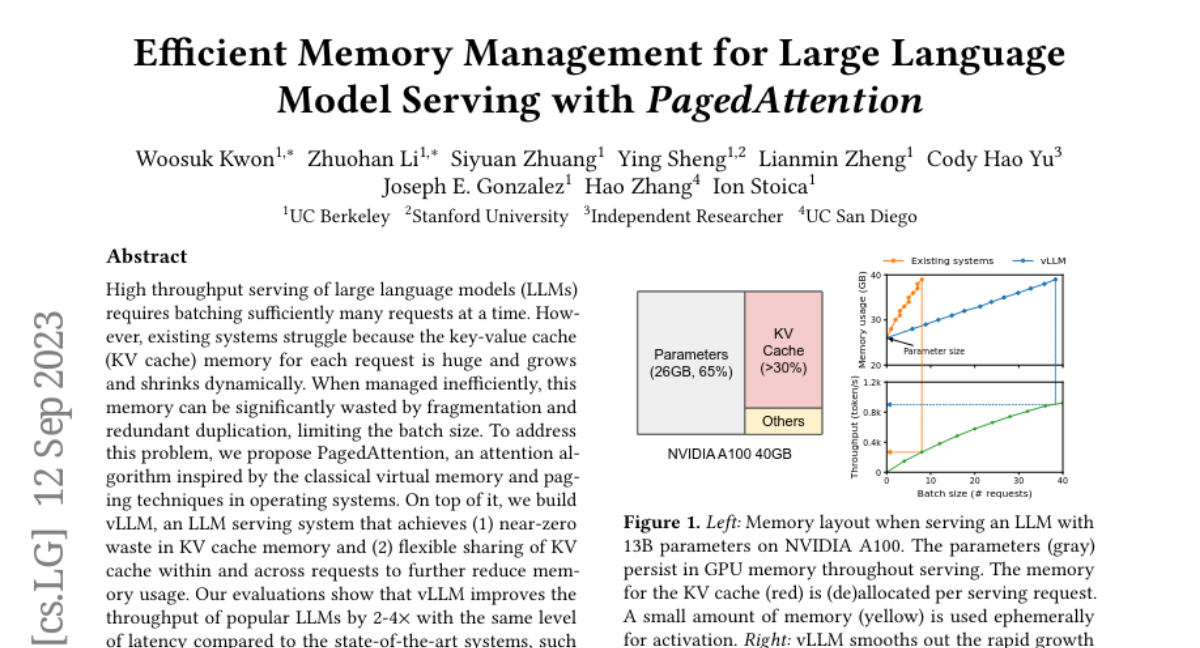
Efficient Memory Management for Large Language Model Serving with PagedAttention

PagedAttention algorithm and vLLM system enhance the throughput of large language models by efficiently managing memory and reducing waste in the key-value cache.

  • 9 authors
· Sep 12, 2023

Bitnet.cpp: Efficient Edge Inference for Ternary LLMs

Bitnet.cpp enhances edge inference for ternary LLMs using a novel mixed-precision matrix multiplication library, achieving significant speed improvements over baselines.

  • 10 authors

· Feb 17, 2025
Submitted by
akhaliq

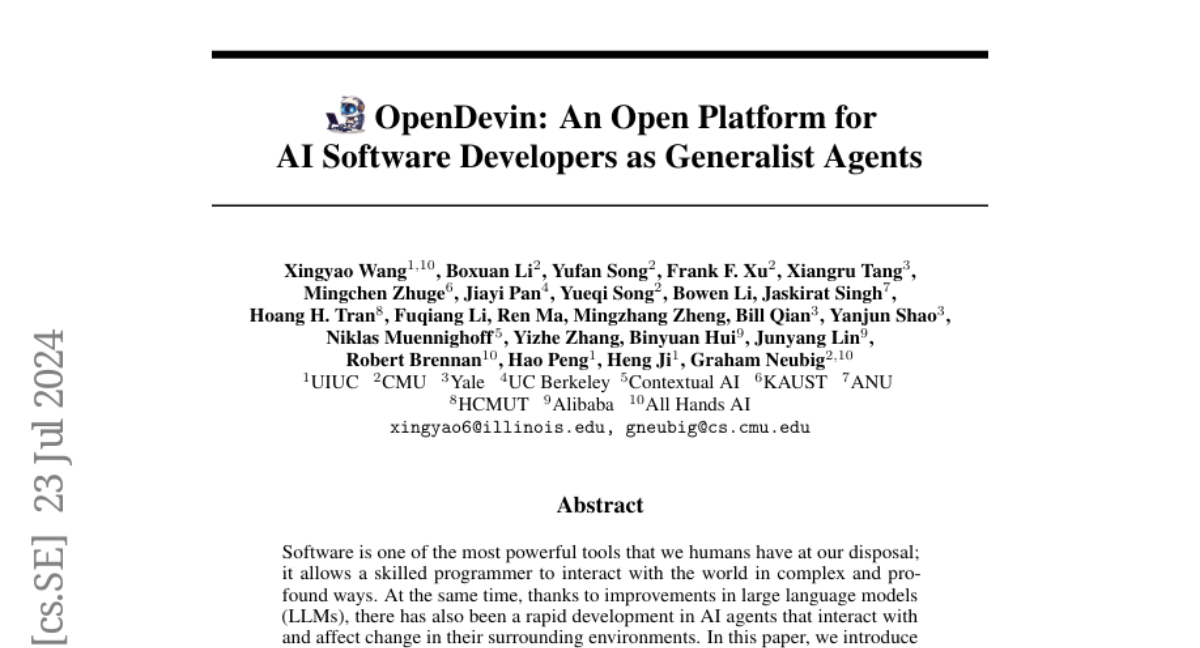
OpenDevin: An Open Platform for AI Software Developers as Generalist Agents

OpenDevin is a platform for developing AI agents that interact with the world by writing code, using command lines, and browsing the web, with support for multiple agents and evaluation benchmarks.

  • 24 authors
· Jul 23, 2024
Submitted by
taesiri

MinerU2.5: A Decoupled Vision-Language Model for Efficient High-Resolution Document Parsing

MinerU2.5, a 1.2B-parameter document parsing vision-language model, achieves state-of-the-art recognition accuracy with computational efficiency through a coarse-to-fine parsing strategy.

  • 61 authors
· Sep 26, 2025
Submitted by
cherubicxn

Learning Heterogeneous Tactile Representation for General Dexterous Manipulation

LingBot-Touch is a tactile foundation model that learns a unified, extensible representation across heterogeneous tactile sensors, yielding plug-and-play tactile tokens that consistently enhance manipulation policies such as diffusion policy and VLA models.

robbyant Robbyant · Nov 9, 2026
Submitted by
taesiri

AgentScope 1.0: A Developer-Centric Framework for Building Agentic Applications

AgentScope enhances agentic applications by providing flexible tool-based interactions, unified interfaces, and advanced infrastructure based on the ReAct paradigm, supporting efficient and safe development and deployment.

  • 23 authors
· Aug 22, 2025
Submitted by
akhaliq

Very Large-Scale Multi-Agent Simulation in AgentScope

Enhancements to the AgentScope platform improve scalability, efficiency, and ease of use for large-scale multi-agent simulations through distributed mechanisms, flexible environments, and user-friendly tools.

  • 8 authors
· Jul 25, 2024
Submitted by
RuofengYang

ARIS: Autonomous Research via Adversarial Multi-Agent Collaboration

ARIS is an open-source research harness that uses cross-model adversarial collaboration to ensure reliable long-term research outcomes through coordinated execution, orchestration, and assurance layers.

Submitted by
yunyangge

MovieRoll: A Systematic Framework for Rolling Out Long-Form Videos

Streaming video generation must sustain quality beyond the training horizon while handling self-generated history and growing cache costs. To address these challenges, we present MovieRoll, a base-to-distilled framework that connects streaming fine-tuning, long-rollout distillation, and long-horizon inference. We first establish a robust multi-step base through Window-wise Teacher Forcing (WinTF), which jointly denoises chunks at progressive noise levels with bidirectional attention within each window and causal access to preceding history. To retain historical context efficiently, hierarchical KV-cache compression (HieraKV) exploits layer-wise attention patterns, retaining full history in shallow layers and sink--recent history in deeper layers. This reduces cache memory by up to 78% while improving generation quality. Building on this base, cumulative long tuning with distribution matching distillation (CuLT-DMD) holds parameters fixed throughout each long self-rollout and averages local gradients before updating. Each update therefore combines supervision across temporal positions while retaining only one local computation graph, enabling efficient long-rollout training of a few-step generator. To extend generation beyond the training horizon, KV recomputation bounds context for both models, while guidance annealing (AnnealCFG) reduces guidance toward the clean endpoint to stabilize MovieRoll-Base. Complementing these modeling advances, FBCA attention and PS-VAE decoding support efficient training and streaming output. On HeliosBench, MovieRoll-Base remains competitive at 30s after training on videos of up to 15s, and MovieRoll-Distilled achieves the highest total scores among the compared methods across single- and multi-event evaluations up to 60s, combining sustained naturalness with active motion.

  • 12 authors
· Nov 16, 2026
Submitted by
akhaliq

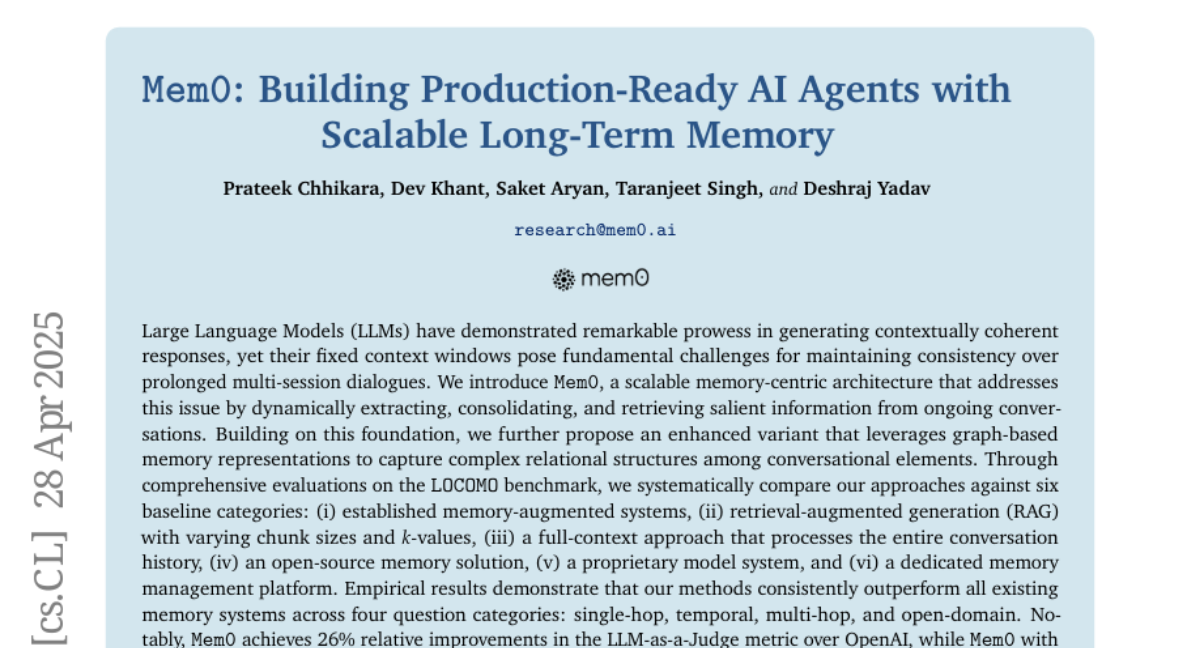
Mem0: Building Production-Ready AI Agents with Scalable Long-Term Memory

Mem0, a memory-centric architecture with graph-based memory, enhances long-term conversational coherence in LLMs by efficiently extracting, consolidating, and retrieving information, outperforming existing memory systems in terms of accuracy and computational efficiency.

  • 5 authors
· Apr 28, 2025

Kronos: A Foundation Model for the Language of Financial Markets

Kronos, a specialized pre-training framework for financial K-line data, outperforms existing models in forecasting and synthetic data generation through a unique tokenizer and autoregressive pre-training on a large dataset.

  • 7 authors
· Aug 2, 2025

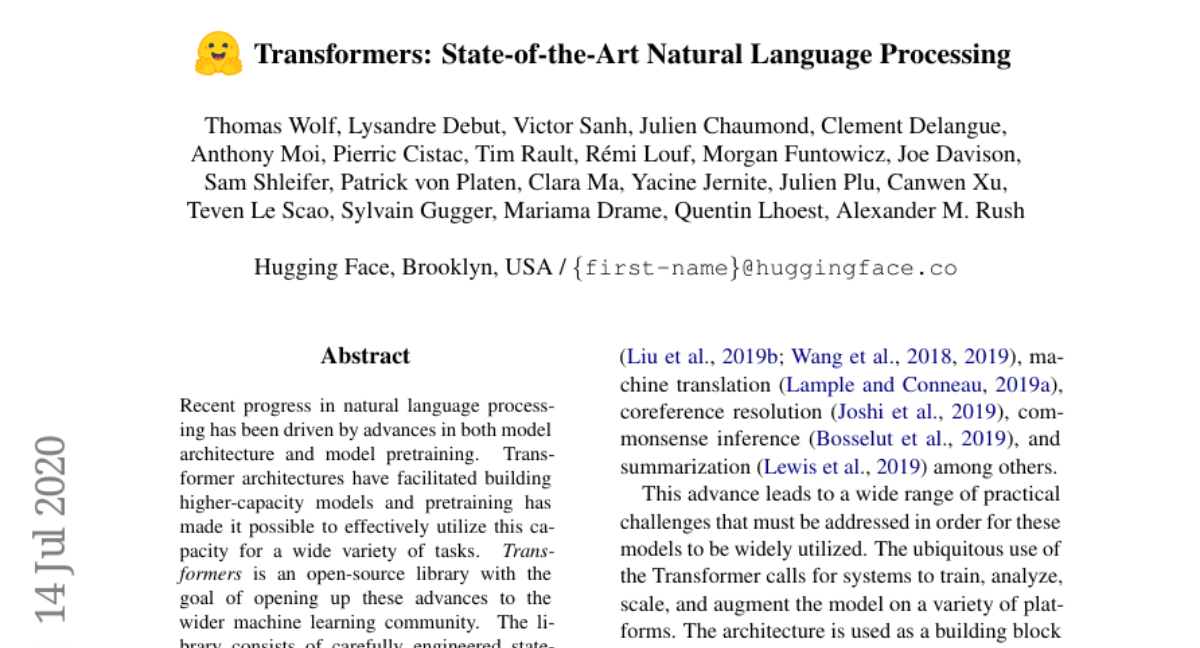
HuggingFace's Transformers: State-of-the-art Natural Language Processing

Transformers library provides state-of-the-art Transformer architectures and pretrained models for natural language processing tasks with a unified API and emphasis on extensibility and robust deployment.

huggingface Hugging Face · Oct 9, 2019
Submitted by
swa2n

e-means: outperforming k-means (in one-tenth the epochs)

Lloyd's k-means algorithm is a long-running standard for clustering, with applications in data analysis, retrieval, quantization and data curation. In this paper, we introduce an exponential moving average optimization procedure for k-means with mini-batch updates, powered by modern deep learning machinery and new insights. We also establish scaling laws on how decay rate and batch size impact final performance. This gives us a formulaic rule to fix them for multiple problem sizes and embedding datasets, without the need for any hyperparameter sweep. The resulting clustering algorithm, coined e-means, is much faster than Lloyd k-means and converges to lower losses, frequently even beating k-means++. On a wide array of embeddings datasets, it beats the loss of Lloyd k-means at 25 epochs in 1.4 to 2.6 epochs, which translates to 10-45x GPU wall-clock speedups compared to state-of-the-art k-means implementations. As an example, e-means partitions DINO10B, a dataset of 10 billion DINO embeddings, into 16 million clusters in only 2.5 epochs, reaching a loss below Lloyd's at 25 epochs.

meta Meta · Nov 6, 2026
Submitted by
pbicho

MACaQ: Fast, Model Agnostic Calibrated Quantization for Low-Precision Weights and Activations

MACaQ is an MXFP4 W4A4 post-training quantization method that quantizes each linear layer independently using online activation transforms and Hessian-aware refinement, reducing cost while preserving accuracy across language and diffusion models.

Submitted by
andito

SmolDocling: An ultra-compact vision-language model for end-to-end multi-modal document conversion

SmolDocling is a compact vision-language model that performs end-to-end document conversion with robust performance across various document types using 256M parameters and a new markup format.

ibm-granite IBM Granite · Mar 14, 2025
Submitted by
Karl28

MedJev: A System One Vision-Language Decision Model for Fast and Effective Medical Image Understanding

Medical image understanding with vision-language models (VLMs) typically relies on autoregressively generating reasoning and answer tokens. These unnecessary tokens make the inference cost scale with the response length and force the answer to be parsed from free-form text, incurring avoidable latency and decision errors. To this end, we introduce MedJev, a system one vision-language decision model that maps medical images, questions, and candidate answers directly to decisions in a single multimodal forward pass, without any autoregressive generation process. For fast inference, MedJev removes the upper language layers and the generative output pathway, while keeping the full vision pathway and all visual tokens. On this shortened backbone, a decision head scores each candidate by pretrained query--key matching and refines the scores with a lightweight multilayer perceptron (MLP) residual, coupling the pretrained matching structure with task-specific nonlinear discrimination. Built on Qwen3.5-4B, MedJev-4B improves both accuracy and speed over the original model on each of four medical image classification and visual question answering benchmarks, with an absolute accuracy gain of 7.93\% and a 6.04times end-to-end speedup. Further comparison with 20 cutting-edge models shows that MedJev-4B achieves state-of-the-art performance and inference speed among 4B--9B general and medical VLMs, indicating that direct multimodal decision making is an effective route to fast and effective medical image understanding.

Submitted by
ChengCui

PaddleOCR-VL-1.6: Expanding the Frontier of Document Parsing with Under-Optimized Region Refinement and Progressive Post-Training

PaddleOCR-VL-1.6 enhances document parsing performance through targeted data optimization and progressive post-training techniques, achieving state-of-the-art results on OmniDocBench v1.6.

PaddlePaddle PaddlePaddle · Jun 2, 2026
Submitted by
Jack97

ForceHarness: Turning Force into Action and Physics for Frozen Frontier Models

Frontier multimodal models can now control robots zero-shot from images, yet many manipulation tasks depend on contact forces that images cannot show. Bringing force to an API-only frozen model raises two challenges. First, contact evolves much faster than an API model can decide, so the system must close the loop on force beneath the model. Second, a frozen model cannot interpret raw force streams, so force must be returned in a form the model can reason about. Therefore, we present ForceHarness, a harness that lets frozen models use force without demonstrations or finetuning. After calibrating hand force from a wrist sensor or joint torques alone, ForceHarness addresses the first challenge with self-terminating force primitives that regulate force on their own and return at a contact event. To address the second challenge, a physics translation layer turns each force trace into physical quantities with uncertainty as the tool result. To evaluate ForceHarness against expert force controllers and learned policies under identical conditions, we also build HiddenPhys, a seven-task MuJoCo benchmark with hidden physical variables. On a real arm without a wrist force sensor, ForceHarness raises the zero-shot success rate of GPT-6 Astra from 3.3% to 90.0%. In simulation, it adds 17.5 percentage points on the public ForceBench suite and 34.3 percentage points on HiddenPhys, surpassing force-aware policies trained on demonstrations on both benchmarks and matching hand-written expert controllers on HiddenPhys. Ablations further show that smaller models make significantly better decisions when given physical quantities rather than raw force values.

showlab Show Lab · Nov 16, 2026
Submitted by
unilm

VibeVoice Technical Report

VibeVoice synthesizes long-form multi-speaker speech using next-token diffusion and a highly efficient continuous speech tokenizer, achieving superior performance and fidelity.

MicrosoftResearch Microsoft Research · Aug 26, 2025
Submitted by
nielsr

Ultralytics YOLO26: Unified Real-Time End-to-End Vision Models

YOLO26 addresses real-time vision challenges through a unified model family with NMS-free inference, improved training strategies, and multi-task capabilities spanning detection, segmentation, and pose estimation.

Ultralytics Ultralytics · Jun 2, 2026
Submitted by
andy-yang

FreeToken: Efficient Edge-Native MoE Serving with Bandwidth-Adaptive Execution

FreeToken is an edge-native Mixture-of-Experts serving system that dynamically maps computation and model state onto heterogeneous local hardware to run large open-weight models on personal machines.

PyTorch Distributed: Experiences on Accelerating Data Parallel Training

The PyTorch distributed data parallel module optimizes large-scale model training using techniques like gradient bucketing, computation-communication overlap, and selective synchronization to achieve near-linear scalability.

  • 11 authors
· Jun 28, 2020
Submitted by
lhpku20010120

OmniEdu: Open Foundation Models for Learning and Teaching

OmniEdu is a family of instruction-tuned educational foundation models that improve K-12 problem solving, curriculum understanding, and tutoring through capability-balanced training data.

PekingUniversity Peking University · Sep 19, 2026
Submitted by
guanwenhao

VoxMel TTS Technical Report

VoxMel is a tokenizer-free autoregressive TTS framework that uses an invertible two-axis Haar transform to decompose mel spectrograms into Coarse-Mel and residual tiers, enabling stable high-fidelity generation with strong recognition and speaker-similarity results.

VoxDance-Lab VoxDance-Lab · Nov 15, 2026
Submitted by
taesiri

Unlimited OCR Works

Unlimited OCR introduces Reference Sliding Window Attention to eliminate growing memory consumption during long-sequence OCR tasks, enabling efficient transcription of multiple pages in a single forward pass.

baidu BAIDU · Jun 22, 2026

OmniFlatten: An End-to-end GPT Model for Seamless Voice Conversation

A novel GPT-based model, OmniFlatten, enables real-time natural full-duplex spoken dialogue through a multi-stage post-training technique that integrates speech and text without altering the original model's architecture.

  • 9 authors
· Oct 23, 2024

Zep: A Temporal Knowledge Graph Architecture for Agent Memory

Zep, a memory layer service, outperforms MemGPT in the DMR benchmark and LongMemEval by excelling in dynamic knowledge integration and temporal reasoning, critical for enterprise use cases.

  • 5 authors
· Jan 20, 2025
Submitted by
XINLI1997

AllocFlow: End-to-End Portfolio Trading Action Generation from Raw Market Data

An end-to-end flow-matching framework generates joint portfolio allocations from raw multi-asset market histories via a cross-asset flow Transformer and a two-stage imitation and group-relative reinforcement learning procedure, improving risk-adjusted returns on cryptocurrency perpetual futures.

A decoder-only foundation model for time-series forecasting

A large language model adapted for time-series forecasting achieves near-optimal zero-shot performance on diverse datasets across different time scales and granularities.

  • 4 authors

· Oct 14, 2023
Submitted by
alexiglad

Energy-Based Reasoners: Your Recurrent Reasoner Should Be an Energy-Based Model

Energy-Based Reasoners guide looped latent reasoning by learning an energy function whose gradient refines states and signals when to stop, with exploration-based training improving performance and efficiency.

  • 5 authors
· Nov 6, 2026
Submitted by
milkkarten

Prime Agent: A Self-Improving RLM Harness

Prime Agent is an open-source harness that uses recursive subagents, persistent computation, and agent-to-agent coordination to extend language models' long-horizon capabilities across coding and reasoning tasks.

PrimeIntellect Prime Intellect · Aug 24, 2026
Submitted by
jaychempan

Duo: A Reciprocal World Model for Full-Duplex Interaction

A reciprocal world model enables real-time full-duplex audiovisual interaction by jointly modeling intent and realization using autoregressive reasoning, synchronized attention, and dual rollout distillation.

inclusionAI inclusionAI · Nov 11, 2026
Submitted by
a43992899

YuE2: Unifying Symbolic and Audio Music Generation at Frontier Quality

YuE2 unifies symbolic and audio music generation via symbolic planning, producing readable scores and full-song audio with state-of-the-art quality and agentic editing capabilities.

Submitted by
caizhongang

Has GPT-6-Astra Achieved Embodied Intelligence?

GPT-6-Astra achieves high performance across diverse robotic tasks via in-context learning, yet real-world deployment reveals gaps in demonstration cost, execution time, and practical embodied intelligence.

sensenova SenseNova · Oct 15, 2026
Submitted by
kumboh

Next-Concept Modeling: Fast, Parallel Coarse-to-Fine Text Generation

Next-Concept Modeling uses hierarchical discrete codes and parallel level-wise generation to accelerate diffusion language models while improving quality and reasoning performance.

StanfordUniversity Stanford University · Oct 9, 2026
Submitted by
lgy0404

nanoMuse: An Open-Source Personal Agent for Every Device You Own

Assistants from 2011 answered and waited, and agents from 2023 did a task and stopped. In September 2026 Meta's Muse showed an agent for one person, with accounts, devices, memory and a conversation that lasts, closed, in a vendor's cloud, in one country. Such an agent is expected to act on a person's accounts and devices, remember them across weeks, speak first when it is worth it, and answer for what it did. It is a kind of software, not a model, and until now had no open counterpart. This report defines the personal agent in five questions and three horizons. It reads how Muse is built from Meta's public record and a copy of its production prompt, each statement marked by its source. It then presents nanoMuse, the open-source counterpart under the GPL-3.0, one agent on every device a person owns, with hands on the phone's screen and the computer's. They share one conversation over a relay anyone can run; every action goes through a Sentinel, memory is files the person can read, and the model is their choice. Its size and cost are given as estimates. What is open, memory with provenance, an evaluation suite for the hands and an open model for them, is set out as a roadmap.

zju Zhejiang University · Oct 6, 2026
Submitted by
ghy0324

JVT: Just Video Transformer makes pixel-space video diffusion simple

A simple DiT-style Transformer enables pixel-space video diffusion without pretrained autoencoders or U-Net components, achieving competitive quality and supporting joint camera-conditioned RGB-disparity generation.

  • 3 authors
· Nov 13, 2026
Submitted by
HarrisonPENG

TCP4D: A Unified Tool-Center-Point Tracking and Generation Model for Robot Manipulation

Robot manipulation videos provide a rich visual experience, yet recovering robot action and gripper-state annotations from RGB observations still remains challenging. Using the embodiment-agnostic tool-center-point (TCP) pose as the action space, we present TCP4D, a unified model in which a shared 4D scene representation both tracks observed TCP motion and generates future TCP trajectories. Given a monocular video and initial 2D TCP queries, the tracker directly recovers metric TCP poses in SE(3) and gripper states alongside scene geometry and camera parameters. The generator samples local features from the same 4D representation along the recovered TCP tracks, then combines them with robot observations and language instructions to predict future TCP states. Our new cross-embodiment augmentation pipeline converts existing RGB videos into demonstrations for alternative embodiments by retargeting the recovered motion and synthesizing the corresponding observations, without recorded source-robot states. Experiments show that the tracker achieves absolute trajectory errors of 7.60 and 16.07 mm on DROID and RoboLab and adapts to a new embodiment with only ten demonstrations. The generator achieves 69.19% mean success on RoboTwin and outperforms well-established policy models on two real-world tasks, while joint training on source and augmented demonstrations improves target-robot success by 41.5% over augmented-only training.

  • 8 authors
· Nov 17, 2026
Submitted by
supra3d

SUPRA-TEX: 3D Generation with Super-Aligned Texture

SUPRA-Tex decouples visible-material estimation, surface alignment, and 3D completion to generate relightable 3D materials that preserve reference image details and complete unobserved surfaces.

  • 8 authors
· Oct 15, 2026

PDFMathTranslate: Scientific Document Translation Preserving Layouts

PDFMathTranslate enables layout-preserving scientific document translation using large language models and precise layout detection, offering improved precision, flexibility, and efficiency.

  • 4 authors
· Jul 2, 2025
Submitted by
HaoKang

Evolving Infra: Agent-Adaptive LLM Serving at Scale

Agentic workloads are a major source of LLM inference demand. Existing prefill--decode (PD) disaggregated serving systems offer limited flexibility for runtime adaptation of compute allocation and KV cache management, and rely on coarse signals that only partly capture the diverse and dynamic agent workload. These limitations lead to load imbalance between prefill and decode nodes and eviction of KV caches that agents will reuse. We present Evolving Infra, an agent-adaptive serving framework that adapts compute allocation to agent workloads and KV cache management to agent context management at runtime. We decouple compute allocation from key--value (KV) cache management, allowing nodes to switch efficiently between prefill and decode. Building on this design, an online planner matches the PD split to workload composition, while an agent-aware distributed KV manager guides cache eviction and transfer with signals from agent context management. Across coding, math, and computer-use tasks with GLM-5.2 and Kimi K2.6 on up to 256 GB300 GPUs, Evolving Infra reduces mean end-to-end request latency and P95 TTFT by up to 4.1x and 14x over Dynamo, NVIDIA's production framework.

mit-han-lab MIT HAN Lab · Nov 9, 2026
Submitted by
Rbin

RAG-Anything: All-in-One RAG Framework

RAG-Anything is a unified framework that enhances multimodal knowledge retrieval by integrating cross-modal relationships and semantic matching, outperforming existing methods on complex benchmarks.

Submitted by
BradNLP

Flide: Accelerating Decision Inference with Exact State Forking

Flide is an exact inference engine that accelerates decision-model LLM agents by decoupling logical request trees from physical execution and using ForkAttention to preserve exact branch evaluations.