

Assistax: A Multi-Agent Hardware-Accelerated Reinforcement Learning Benchmark for Assistive Robotics
Paper • 2507.21638 • Published
Exception:    SplitsNotFoundError
Message:      The split names could not be parsed from the dataset config.
Traceback:    Traceback (most recent call last):
                File "/usr/local/lib/python3.14/site-packages/datasets/inspect.py", line 286, in get_dataset_config_info
                  for split_generator in builder._split_generators(
                                         ~~~~~~~~~~~~~~~~~~~~~~~~~^
                      StreamingDownloadManager(base_path=builder.base_path, download_config=download_config)
                      ^^^^^^^^^^^^^^^^^^^^^^^^^^^^^^^^^^^^^^^^^^^^^^^^^^^^^^^^^^^^^^^^^^^^^^^^^^^^^^^^^^^^^^
                  )
                  ^
                File "/usr/local/lib/python3.14/site-packages/datasets/packaged_modules/webdataset/webdataset.py", line 81, in _split_generators
                  first_examples = list(islice(pipeline, self.NUM_EXAMPLES_FOR_FEATURES_INFERENCE))
                File "/usr/local/lib/python3.14/site-packages/datasets/packaged_modules/webdataset/webdataset.py", line 32, in _get_pipeline_from_tar
                  fs: fsspec.AbstractFileSystem = fsspec.filesystem("memory")
                                                  ~~~~~~~~~~~~~~~~~^^^^^^^^^^
                File "/usr/local/lib/python3.14/site-packages/fsspec/registry.py", line 302, in filesystem
                  cls = get_filesystem_class(protocol)
                File "/usr/local/lib/python3.14/site-packages/fsspec/registry.py", line 239, in get_filesystem_class
                  raise ValueError(f"Protocol not known: {protocol}")
              ValueError: Protocol not known: memory

              The above exception was the direct cause of the following exception:

              Traceback (most recent call last):
                File "/src/services/worker/src/worker/job_runners/config/split_names.py", line 66, in compute_split_names_from_streaming_response
                  for split in get_dataset_split_names(
                               ~~~~~~~~~~~~~~~~~~~~~~~^
                      path=dataset,
                      ^^^^^^^^^^^^^
                      config_name=config,
                      ^^^^^^^^^^^^^^^^^^^
                      token=hf_token,
                      ^^^^^^^^^^^^^^^
                  )
                  ^
                File "/usr/local/lib/python3.14/site-packages/datasets/inspect.py", line 340, in get_dataset_split_names
                  info = get_dataset_config_info(
                      path,
                  ...<6 lines>...
                      **config_kwargs,
                  )
                File "/usr/local/lib/python3.14/site-packages/datasets/inspect.py", line 291, in get_dataset_config_info
                  raise SplitsNotFoundError("The split names could not be parsed from the dataset config.") from err
              datasets.inspect.SplitsNotFoundError: The split names could not be parsed from the dataset config.
Need help to make the dataset viewer work? Make sure to review how to configure the dataset viewer, and open a discussion for direct support.
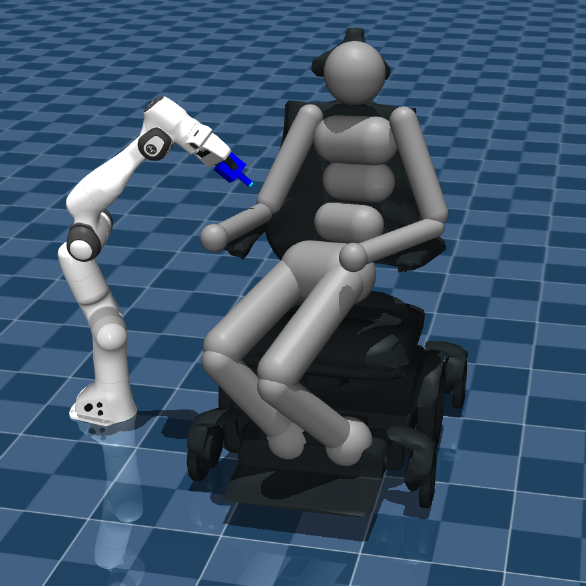
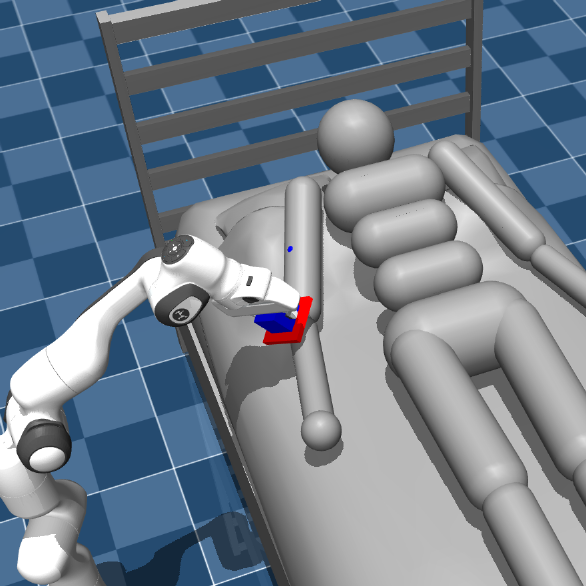
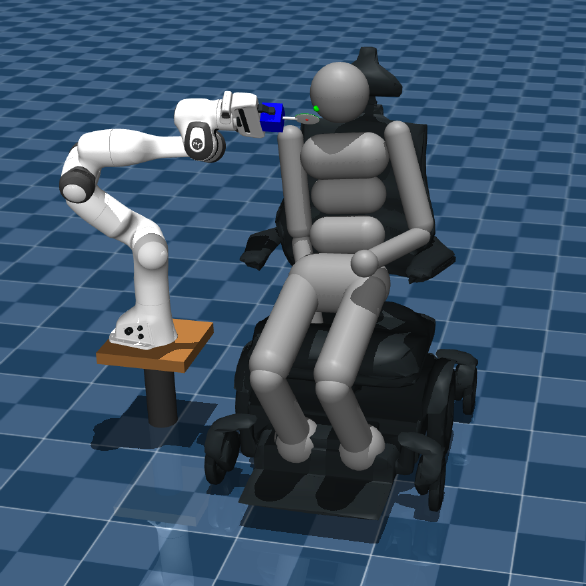
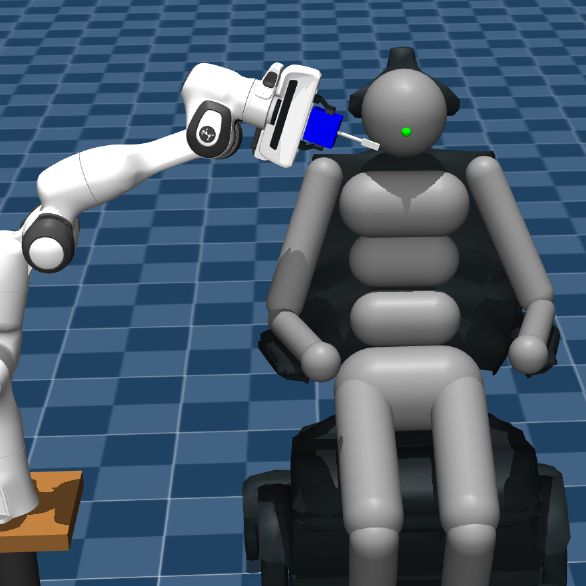
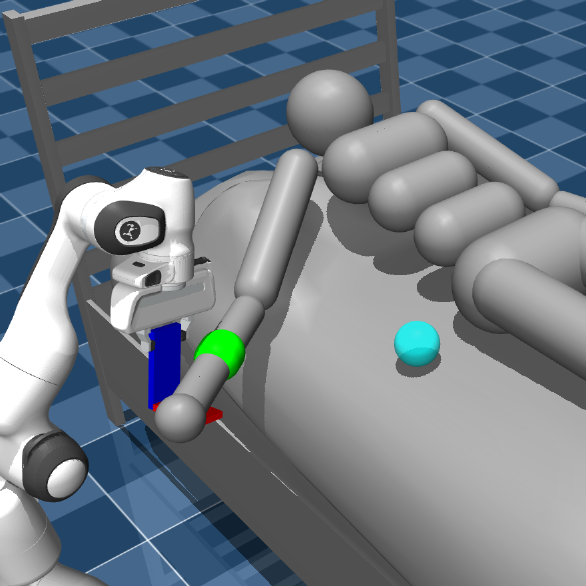
A population of pre-trained partner policies for Assistax, a multi-agent hardware-accelerated reinforcement learning benchmark for assistive robotics. Each "human" in the zoo is a policy trained with its own sampled preferences over how it likes to be assisted — how fast the robot should move, how much contact force it should apply, how much unexpected touching it tolerates. Together they form the partner pool for zero-shot coordination (ZSC) and ad-hoc teamwork (AHT) experiments, where a robot has to work with partners it has never trained against.
| 📄 Paper | Assistax: A Multi-Agent Hardware-Accelerated Reinforcement Learning Benchmark for Assistive Robotics (Reinforcement Learning Journal, 2026) |
| 💻 Code | assistive-autonomy/assistax |
| ⚖️ License | Apache 2.0 |
| 📦 Contents | zoo.tar.gz (~728 MB) |
team_uuid. Across all five tasks that is 3,150 human+robot teams, 6,300 agents in total.scratchitch, bedbathing, armmanipulation, feeding, teethbrushing.pushcoop and handover environments are robot–robot and have no preference rewards, so they have no zoo entries.Humans within a task are distinguished by their preference weights w_speed, w_force and w_touch, which are sampled per agent — the population is deduplicated on those weights (plus disability settings), so no two humans in a task share an identity.
The archive is around 728 MB, so give it a moment.
hf download leohink/assistax-zoo zoo.tar.gz --repo-type dataset --local-dir .
tar -xzf zoo.tar.gz
Or without the Hugging Face CLI:
wget https://huggingface.co/datasets/leohink/assistax-zoo/resolve/main/zoo.tar.gz
tar -xzf zoo.tar.gz
Then point Assistax at the extracted zoo/ directory by setting ZOO_PATH in assistax/baselines/ZSC/config/ppo_aht.yaml (or sac_aht.yaml, or crossplay_zoo.yaml), which defaults to ./zoo:
ZOO_PATH: /path/to/zoo
zoo/
  index.csv                        # one row per agent
  config/<agent_uuid>.yaml         # the full training config for that agent
  params/<agent_uuid>.safetensors  # flax parameters, flattened with sep='/'
Every agent is identified by a UUID. Its parameters and the config it was trained under live under that same UUID, which is how the library rebuilds the right network for a given checkpoint.
index.csv columns
| Column | Meaning |
|---|---|
agent_uuid |
Unique id; keys into config/ and params/ |
scenario |
Environment name, e.g. scratchitch |
scenario_agent_id |
robot or human |
algorithm |
IPPO, MAPPO or MASAC |
is_rnn |
Whether the policy is recurrent |
rnn_dim |
GRU hidden size when recurrent, else 0 |
team_uuid |
Shared by the robot and human trained together |
w_speed |
Weight on the human's speed preference |
w_force |
Weight on the human's contact-force preference |
w_touch |
Weight on the touch penalty (always negative) |
Humans are differentiated by a preference reward that sits on top of the task reward:
The positive components are budget-normalised (reward_budget = 1.5 by default), so the maximum preference reward per step is the same for every human regardless of how their individual weights came out — what changes is which behaviour earns it. Full formulas, meta-ranges and sampling mechanics are in assistax/envs/README.md.
One thing to watch when loading these policies: agents trained with preference rewards observe 7 extra preference dimensions on top of the base observation, so their first layer is wider than a vanilla policy for the same environment.
The library handles the index, the architecture reconstruction and the parameter loading. It is pip-installable straight from GitHub:
# NVIDIA GPU (CUDA 12); use [cuda13] or [cpu] as appropriate
pip install "assistax[cuda12] @ git+https://github.com/assistive-autonomy/assistax.git"
from assistax.wrappers.aht import ZooManager

zoo = ZooManager("/path/to/zoo")

# Pick the humans for one task
humans = zoo.index[
    (zoo.index.scenario == "scratchitch")
    & (zoo.index.scenario_agent_id == "human")
]
print(len(humans), "humans available")

agent = zoo.load_agent(humans.iloc[0].agent_uuid)
# agent.apply_fn         -> flax apply function
# agent.params           -> parameter pytree
# agent.hstate_reset_fn  -> initial hidden state (None for feed-forward policies)
ZooManager reads config/<uuid>.yaml to decide which network to rebuild — IPPOActorCritic, IPPOActorCriticRNN, MAPPOActor, MAPPOActorRNN or SACActor. The default ff_nps network is a feed-forward actor and critic with 128-unit hidden layers, ReLU activations and no parameter sharing between agents.
If you would rather not depend on Assistax, the parameters are plain safetensors:
import safetensors.flax
from flax.traverse_util import unflatten_dict

flat = safetensors.flax.load_file("zoo/params/<agent_uuid>.safetensors")
params = unflatten_dict(flat, sep="/")
With ZOO_PATH set, train a PPO robot against the pre-trained partner population:
uv run python assistax/baselines/ZSC/ppo_aht.py ENV_NAME=scratchitch
There is a SAC variant too (assistax/baselines/ZSC/sac_aht.py).
The population is split into train and test partners. By default this is a random split controlled by SPLIT_RATIO in the AHT config (0.25 in ppo_aht.yaml, 0.2 in sac_aht.yaml — 0.25 means 25% train, 75% test). Setting EXTREME_SPLIT instead selects partners by how extreme their preferences are, in one of three modes — single (rank on one preference dimension), multi (rank on several independently) or composite (distance from the population centroid) — which is useful for testing generalisation to partners well outside the training distribution.
You can also run crossplay across the whole population to inspect behavioural diversity:
uv run python assistax/baselines/ZSC/crossplay_zoo.py ENV_NAME=scratchitch
| Task | Description |
|---|---|
Scratch Itch (scratchitch) |
An itch target is sampled on the human's right arm. The robot must reach it and apply a specified force; the human can move their arm to help. |
Bed Bathing (bedbathing) |
52 bathing points are distributed along the human's arm. The robot must wipe each one with sufficient contact force before the episode ends. |
Arm Assist (armmanipulation) |
The human is too weak to lift their arm alone. The robot must align with a section of the arm and move it into a comfortable resting position. |
Feeding (feeding) |
The robot navigates a spoon to the mouth of a human seated in a wheelchair, keeping the spoon correctly oriented, moving at the right speed and making gentle contact. |
Teeth Brushing (teethbrushing) |
The robot approaches the mouth with a toothbrush, aligns the bristles and brushes with an appropriate tangential speed and contact force. |
All tasks are two-agent, built on Brax/MJX with continuous Box(-1, 1) actions and 1000-step episodes.
Apache 2.0, matching the Assistax library.
If you use the Assistax zoo in your work, please cite:
@article{hinckeldey2026assistax,
    title={Assistax: A Multi-Agent Hardware-Accelerated Reinforcement Learning Benchmark for Assistive Robotics},
    author={Leonard Hinckeldey and Elliot Fosong and Rimvydas Rubavicius and Elle Miller and Trevor McInroe and Fan Zhang and Patricia Wollstadt and Stefano V. Albrecht and Subramanian Ramamoorthy},
    journal={Reinforcement Learning Journal},
    volume={7},
    pages={},
    year={2026}
}